
Biofertilizers vs. Synthetic Fertilizers: A Comprehensive Analysis of Benefits, Costs, and Applications

Updated: Oct 6

Introduction
In the face of growing environmental concerns, soil degradation, and the urgent need for sustainable agriculture, the debate between biofertilizers and synthetic fertilizers is more relevant than ever. Biofertilizers are formulations that contain live microbes that increase nutrient availability to crops. The living microorganisms in biofertilizers convert naturally occurring minerals into plant-available nutrients, improving soil fertility and boosting crop production. (1) Synthetic fertilizers are chemicals that supply nutrients to plants, but their overuse can harm soil health, pollute water, and disrupt the ecosystem. (2) Rather than treating them as opposites, recent research suggests a balanced approach: use biofertilizers to improve nutrient efficiency and reduce synthetic fertilizer use while maintaining high yields.
This blog explores the key differences, advantages, limitations, costs, and practical applications of both biofertilizers and synthetic fertilizers, showing that a balanced use of both can support modern agriculture.
What are Biofertilizers
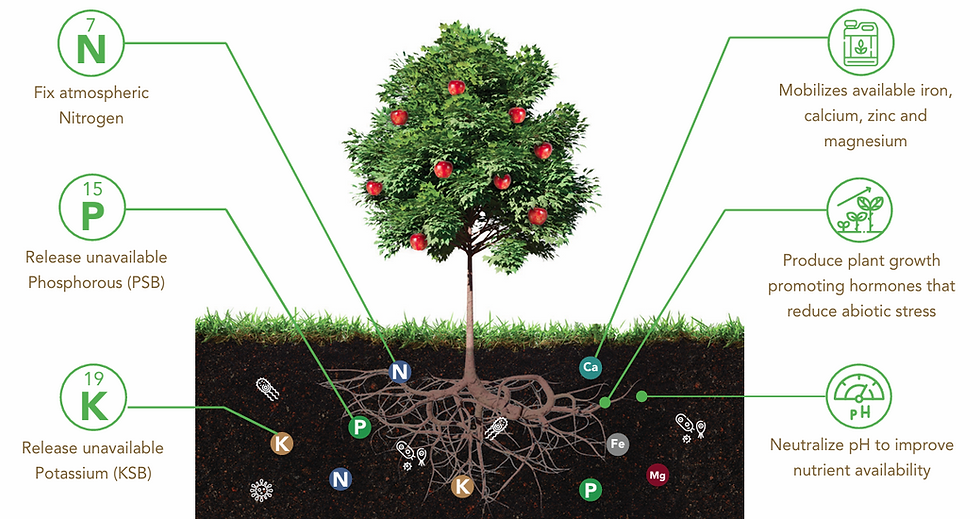
Biofertilizers are products containing beneficial living microorganisms such as bacteria, fungi and algae. These microbes enhance plant growth by increasing the availability of essential nutrients through natural processes such as nitrogen fixation, phosphorus solubilization, and the production of growth-promoting compounds. By enriching the soil’s nutrient cycle and increasing organic matter, biofertilizers help plants grow more vigorously while supporting long-term soil fertility and ecosystem health. Biofertilizers are mainly classified into the following categories:
Nitrogen Biofertilizers
Phosphorus Solubilizing Biofertilizers
Potash Solubilizing Biofertilizers
Other types
These categories have been discussed in detail in our earlier blog, Understanding Biologicals for Sustainable Agriculture.
What are Synthetic Fertilizers
Fertilizers are natural or synthetic substances (excluding liming materials) that provide essential nutrients required for healthy plant growth. They can be applied directly to the soil or to plant tissues to improve nutrient availability, enhance growth, and correct nutrient deficiencies. (6)
Synthetic fertilizers are industrially produced and mainly supply three key nutrients: nitrogen, phosphorus, and potassium. They are available in precise ratios, allowing targeted nutrient management. They are commonly classified into three groups: nitrogen fertilizers, such as Urea and DAP; phosphorus fertilizers, such as superphosphate and triple phosphate; and potassium fertilizers, such as potassium chloride, potassium sulphate, and potassium nitrate. (6)
Synthetic fertilizers, particularly nitrogen-based ones, have played a vital role in enhancing crop yield since the Green Revolution of the 1960s. To meet the food demands of a growing population, their use was expanded, leading to significant gains in agricultural productivity. These advances were largely driven by the adoption of high-yielding crop varieties combined with intensive use of fertilizers and pesticides. This approach primarily aims to maximize grain yield, with little attention to the long-term effects on soil health, plants, and the broader ecosystem. In contrast, sustainable agriculture offers a balanced way to increase crop production while addressing these critical concerns. (7)
Comparative Analysis of Biofertilizers and Synthetic Fertilizers
1. Nutrient Availability:
Biofertilizers enhance long-term soil fertility by supporting natural nutrient cycling and gradually releasing nutrients. Unlike synthetic fertilizers, they provide nutrients more slowly, ensuring sustained availability for plants.
Synthetic fertilizers supply precise and consistent amounts of nutrients directly to the soil and can be especially useful for rescuing severely nutrient-deficient or dying plants. However, excessive use may cause nutrient imbalance, harm beneficial soil microbes, and negatively affect plant and soil health. (3)
2. Environmental Impact:
Biofertilizers are environmentally safe, biodegradable, and non-polluting alternatives for sustainable agriculture. By relying on natural processes such as nitrogen fixation, phosphorus solubilization, and organic matter enrichment, they minimize the release of harmful substances into the environment. Their use helps reduce greenhouse gas emissions associated with synthetic fertilizer production and application, while also supporting soil biodiversity by enhancing beneficial microbial communities. Thus, biofertilizers contribute to sustainable agriculture by improving productivity without compromising environmental health.
Synthetic fertilizers provide quick nutrient availability to plants, but their excessive and long-term use poses serious environmental concerns. Overapplication can lead to nutrient leaching and runoff, contaminating water bodies and causing eutrophication and algal blooms. The production and use of synthetic fertilizers also contribute significantly to greenhouse gas emissions, particularly nitrous oxide. In addition, continuous reliance on these fertilizers can degrade soil health by disrupting microbial diversity and reducing organic matter.
3. Soil Health
Biofertilizers play a vital role in maintaining and improving soil health by enriching the soil with the beneficial microorganisms that enhance nutrient cycling and organic matter content. These microbes fix atmospheric nitrogen, solubilize and mobilize phosphorus, potash, and other essential nutrients, making them more accessible to plants. Microbes present in these biofertilizers produce phytohormones and beneficial compounds that stimulate plant growth. In addition, the microbial activity of biofertilizers improves soil structure, aeration, and water-holding capacity, creating a more balanced and fertile environment for sustainable plant growth.
Synthetic fertilizers are effective for short-term plant growth, but continuous and excessive use can negatively impact soil health. They may disrupt the natural balance of soil microorganisms, reduce organic matter, degrade soil structure, reduce water-holding capacity, and cause nutrient imbalances. Overreliance on synthetic inputs can also cause soil acidification and salinity, ultimately reducing soil productivity in the long run. (4)
4. Crop Yield Consistency
Biofertilizers contribute to improved crop yield by enhancing nutrient availability, stimulating root growth, and supporting overall plant health. Unlike synthetic fertilizers that provide an immediate nutrient boost, biofertilizers work gradually by establishing beneficial microbial populations in the soil. This sustained nutrient release supports consistent crop growth over time while improving soil fertility for future cultivation. While their effectiveness can vary depending on crop type, soil conditions, and microbial compatibility, they still contribute significantly to higher yields and long-term agricultural sustainability.
Synthetic fertilizers provide a quick and reliable supply of nutrients, often resulting in immediate improvements in crop yields and more uniform growth across fields. Their precise nutrient formulations allow farmers to target specific deficiencies, ensuring consistent crop performance in the short term. However, this consistency can decline over time as soil health deteriorates due to reduced microbial activity, loss of organic matter, and structural degradation.
5. Cost and Accessibility
Biofertilizers are usually cheaper than synthetic fertilizers and help reduce farming costs by improving soil fertility naturally. However, their availability can be limited in some areas due to production and storage challenges, and because they contain living microbes, they require careful handling and timely application. Despite these challenges, their low cost and sustainability benefits make them a valuable option for farmers.
Synthetic fertilizers are widely available and easy to apply, offering farmers quick access to essential nutrients. However, they are often more expensive than biofertilizers, and their costs can fluctuate with energy prices and global markets. They ensure immediate results, but long-term reliance can increase farming expenses due to soil degradation and the need for repeated applications. When used strategically, they can still serve as a practical option for meeting urgent nutrient needs.
Method of Application of Biofertilizers:
Biofertilizers are applied in several ways to ensure effective colonization of plant roots by beneficial microbes. Certain precautions should be observed before applying biofertilizers, such as storing the products at an optimum temperature (neither below 0°C nor above 35°C), avoiding the use of solutions kept overnight, and protecting them from direct sunlight. Different methods of application of Biofertilizers are (5):
1. Seed treatment: Seeds are coated with biofertilizer, and the application rate may vary depending on the type of biofertilizer and the seed being used:
a. For dry formulation: In this method, 200 g of biofertilizer is mixed with 300-400mL of water to create a slurry, which is then combined with 10 kg of seeds. The coated seeds are spread on a clean sheet to dry in the shade, and once dry, they are ready for sowing. (5)
b. For Liquid formulation: In this method, 3- 5 mL of liquid biofertilizer is recommended per kilogram of seeds. Generally, larger seeds require a greater amount than smaller seeds. (5)
2. Seedling dip: In this method, seedlings are dipped in biofertilizer solution before transplantation. It is commonly used for transplanted crops such as rice.
3. Soil application: Biofertilizers can be applied directly to the soil to enhance microbial activity and nutrient availability. They can be mixed with compost, organic matter or manure before being incorporated into the soil. Proper soil application allows beneficial microbes to establish in the rhizosphere, improving nutrient cycling, soil fertility, and overall plant growth.
4. Foliar application: In foliar application, biofertilizers are sprayed directly onto the leaves of plants, allowing the beneficial microbes to be absorbed through the leaf surface. Foliar application can help improve plant health, stimulate growth, and enhance resistance to certain stresses, complementing soil or seed-based biofertilizer methods.

Method of Application of Synthetic Fertilizers
For using Synthetic fertilizers, there are various methods of application. These are generally applied directly to the soil or sprayed onto plant foliage as granules, powders, or liquid solutions. They dissolve quickly and release nutrients that plants can immediately absorb. Some common methods are below:
Foliar application: In this method, fertilizers are sprayed directly onto plant leaves, allowing nutrients to be absorbed quickly through the leaf surface.
Broadcasting: a method of applying fertilizers by spreading them evenly across the entire field. It is well-suited for large areas and can be carried out either manually or with mechanical spreaders.
Band application: In this method, the fertilizers are applied in a narrow strip along the planting row. This method is especially effective for row crops and helps improve nutrient use efficiency by minimizing fertilizer waste.
Fertigation: a method for applying fertilizers through the irrigation system, delivering nutrients directly to the root zone along with water. This method improves nutrient use efficiency and is particularly useful for high-value crops and precise nutrient management. (8,9)


Integrated Nutrient Management: A Balanced Approach
With rising global food demand driven by population growth and the urgent need for eco-friendly strategies to sustain the soil–plant–microbe–environment system, it has become essential to focus on approaches that enhance agricultural productivity. One way to increase production is to use synthetic fertilizers, but their overuse has numerous adverse effects on our soil, plants, and ecosystem. While organic manures and biofertilizers are valuable for soil health, they cannot by themselves supply all the nutrients required for optimal crop growth. Therefore, Integrated Nutrient Management offers the most effective solution, allowing farmers to combine biofertilizers with reduced amounts of synthetic fertilizers to maintain soil health, support strong plant growth, and achieve better crop yields. (10) While Biofertilizers and Synthetic fertilizers are the main components of Integrated Nutrient Management (INM), organic manure, crop rotation and green manure are also important components, as shown in the diagram below.
Biofertilizers play a key role in Integrated Nutrient Management (INM) strategies by improving soil productivity and sustainability, while providing renewable, eco-friendly, and cost-effective nutrient sources that complement synthetic fertilizers in sustainable crop production (5). A comprehensive review of the literature shows that Integrated Nutrient Management (INM) significantly enhances crop yields, improves water and nutrient use efficiency, increases farmers’ economic returns, and contributes to better grain quality, soil health, and long-term sustainability compared to conventional practices. (10)
Components of Integrated Nutrient Management

Why Nurture Growth Biofertilizer fits into Modern Agriculture
Nurture Growth Biofertilizer is a multi-microbial biological product designed to improve nutrient efficiency, enhance soil health, and support sustainable crop production. Unlike conventional fertilizers that directly supply nutrients, Nurture Growth works by increasing the availability of nutrients already present in the soil while stimulating biological activity in the root zone.
The formulation contains a diverse consortium of beneficial microorganisms, including nitrogen-fixing bacteria, phosphorus-solubilizing bacteria, potassium-mobilizing microorganisms, plant growth-promoting rhizobacteria (PGPR), and arbuscular mycorrhizal fungi (AMF). Together, these microorganisms help improve nutrient cycling, root development, water uptake, and plant resilience under environmental stress.
Nurture Growth contains both symbiotic and free-living nitrogen-fixing microorganisms, including Rhizobium and Azotobacter, as well as phosphorus-solubilizing bacteria such as Bacillus subtilis and Bacillus pumilus. These beneficial microbes work together to mobilize essential nutrients, support plant growth, and maintain healthy microbial soil diversity.
By improving nutrient use efficiency, Nurture Growth helps growers maximize the value of existing fertility programs while supporting long-term soil health. Rather than replacing synthetic fertilizers entirely, Nurture Growth is designed to complement conventional fertility programs as part of an Integrated Nutrient Management strategy.
Field trials conducted across multiple crops have demonstrated improvements in root development, crop vigour, nutrient uptake, water-use efficiency, and yield potential. In commercial trials, growers have observed yield improvements in crops such as blueberries, sweet corn, grain corn, and sweet potatoes when Nurture Growth was incorporated into their fertility programs. Results may vary depending on crop type, soil conditions, environmental factors, and management practices.
Using Nurture Growth Biofertilizer can help reduce reliance on synthetic fertilizers while supporting more sustainable agricultural practices. By strengthening soil biology and improving nutrient efficiency, Nurture Growth provides growers with a practical solution for building healthier soils, improving crop performance, and enhancing long-term farm sustainability.
Conclusion
Biofertilizers offer a sustainable approach to crop nutrition by enhancing nutrient availability, improving soil health, and supporting plant growth through natural biological processes. Their use can help reduce dependence on synthetic fertilizers while promoting long-term agricultural sustainability. The global biofertilizer market was valued at approximately $1.38 billion in 2024 and is projected to reach $2.83 billion by 2030, reflecting the growing recognition of biological solutions in modern agriculture. (11,12)
While both biofertilizers and synthetic fertilizers have important roles to play, the future of agriculture is unlikely to rely exclusively on either approach. Synthetic fertilizers provide an immediate and reliable source of nutrients that support crop productivity, while biofertilizers improve nutrient efficiency, strengthen soil biology, and enhance long-term soil fertility. Together, they form the foundation of an effective Integrated Nutrient Management strategy.
Products such as Nurture Growth Biofertilizer help growers maximize the value of existing fertility programs by improving nutrient cycling, supporting beneficial microbial activity, and enhancing plant access to nutrients already present in the soil. By integrating biological and conventional fertility practices, growers can improve crop performance, build healthier soils, and increase the long-term sustainability of their operations.
As agriculture faces increasing pressure to produce more food with fewer environmental impacts, biofertilizers will continue to play an important role in helping farmers improve productivity while protecting the health of their soil for future generations.
Disclaimer: This article is provided for educational and informational purposes only. Crop management practices, fertility programs, application rates and growing conditions may vary by crop, location, soil type and production system. Growers should consult a qualified crop specialist, agronomist or other agricultural professional before making changes to their production practices.
Blogger Biography:

Dr. Ankita Garkoti is a Senior Science Officer at Nurture Growth Bio Fertilizer. She has over 9 years of experience in Agriculture research and extension. Her areas of specialization encompass Plant Pathology, Microbiology, Plant Protection, Organic farming, Biofertilizers, Organic Fertilizers, and Biocontrol agents.
She holds a Ph.D. in Plant Pathology and a master's degree in Botany with a specialization in Plant Pathology. Her doctoral research involved an in-depth study of lentil wilt and its management through various practices. She has extensive experience in organizing training programs on Organic and Natural farming techniques for farmers, agricultural growers, students and other stakeholders.
References:
Grand View Research. (2026, June). Biofertilizers market size, share & trends analysis report, 2026–2033. Grand View Research report
Green Wing Services. (2024, November 10). Pros and cons of organic vs. synthetic fertilizers. Green Wing Services
Jat, L. K., Singh, Y. V., Meena, S. K., Meena, S. K., Parihar, M., Jatav, H. S., Meena, R. K., & Meena, V. S. (2015). Does integrated nutrient management enhance agricultural productivity? Journal of Pure and Applied Microbiology, 9(2), 1211–1221.
Joes, B. (2026, February 28). What are the different types of fertilizer application? A guide. GardenerBible. GardenerBible
Jote, C. A. (2023). The impacts of using inorganic chemical fertilizers on the environment and human health. Organic and Medicinal Chemistry International Journal, 13(3), 555864. https://doi.org/10.19080/OMCIJ.2023.13.555864
Mahmud, A. A., Upadhyay, S. K., Srivastava, A. K., & Bhojiya, A. A. (2021). Biofertilizers: A nexus between soil fertility and crop productivity under abiotic stress. Current Research in Environmental Sustainability, 3, 100063. https://doi.org/10.1016/j.crsust.2021.100063
Rai, S., & Shukla, N. (2020). Biofertilizer: An alternative of synthetic fertilizers. Plant Archives, 20(Supplement 2), 1374–1379.
Sabry, K. H. (2015). Synthetic fertilizers: Role and hazards. In S. Sinha (Ed.), Fertilizer technology I: Synthesis (pp. 176–199). Studium Press LLC.
Schütz, L., Gattinger, A., Meier, M., Müller, A., Boller, T., Mäder, P., & Mathimaran, N. (2018). Improving crop yield and nutrient use efficiency via biofertilization—A global meta-analysis. Frontiers in Plant Science, 8, 2204. https://doi.org/10.3389/fpls.2017.02204
Times of Agriculture. (n.d.). How is synthetic fertilizer applied? https://timesofagriculture.org/how-does-one-apply-synthetic-fertilizer.html
Tripathi, S., Srivastava, P., Devi, R. S., & Bhadouria, R. (2020). Influence of synthetic fertilizers and pesticides on soil health and soil microbiology. In M. N. V. Prasad (Ed.), Agrochemicals detection, treatment and remediation: Pesticides and chemical fertilizers (pp. 25–54). Butterworth-Heinemann. https://doi.org/10.1016/B978-0-08-103017-2.00002-7




Comments