
Post-Harvest Season Series: How to Rebuild Soil After a Heavy Yield Season

Updated: Oct 6
Introduction
A successful harvest is a major achievement for any grower. High yields reflect a crop’s ability to capture sunlight, water, carbon dioxide, and essential nutrients and convert them into grain, fruit, vegetables, fiber, and other valuable products. However, greater productivity can also mean greater removal of nitrogen (N), phosphorus (P), potassium (K), sulfur (S), and other nutrients from the field through harvested biomass.
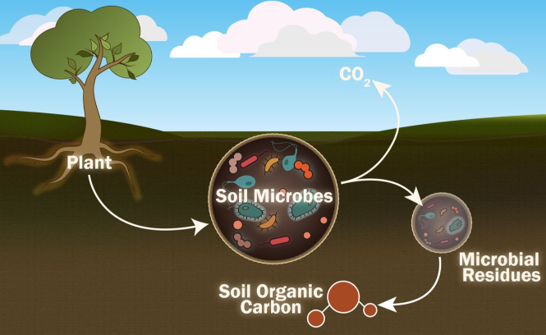
But nutrient removal is only part of the story. Throughout the growing season, the soil functions as a living biological system that supports crop productivity. Plant roots release carbon-rich compounds into the surrounding soil, providing energy for microorganisms. Bacteria, fungi, and other soil organisms contribute to organic matter decomposition, nutrient cycling, soil aggregation, and the transformation of organic materials. When the crop is harvested, these biological processes do not stop. Remaining roots, residues, and remaining organic inputs continue to interact with the soil microbial community and influence nutrient and carbon cycling.
This makes the post-harvest period an important opportunity, not simply to prepare the field for the next crop, but to evaluate, protect, and rebuild the soil system. Crop residues can return carbon and nutrients to the soil as they decompose. Cover crops can maintain living roots and provide additional organic inputs. Appropriate nutrient management can replenish nutrients removed in harvested biomass, while practices that reduce unnecessary soil disturbance and compaction can help protect soil structure and biological habitats.
Therefore, the goal after a high yield season should not be simply to replace what was removed. It should be to rebuild soil resources while maintaining the biological, chemical, and physical processes that make those resources available to the next crop.
Start with a Soil Health Assessment
Before adding fertilizers, amendments, biologicals, or other inputs, the first step is to understand the soil’s current condition. A high-yield season does not affect every field in the same way, and soil nutrient levels, organic matter, biological activity, pH, and physical condition can vary considerably among fields.
A soil health assessment helps identify current nutrient status, what remains available, and where management should be focused. Rather than replacing nutrients or applying inputs based on assumptions, growers can use soil testing and field observations to develop a more targeted post-harvest management plan.
Keep Crop Residue Working for the Soil
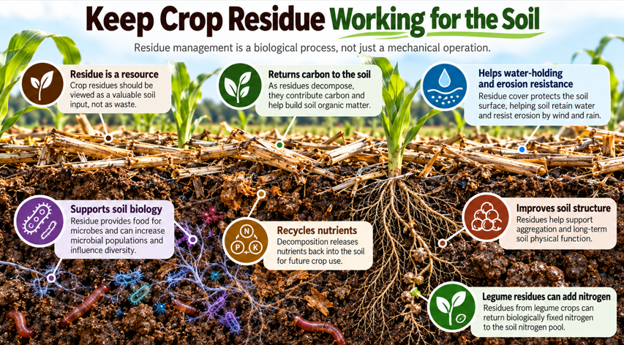
Modern crop production has achieved substantial gains in productivity through improved varieties, fertilizers, crop protection products, and intensive management. However, continuous monoculture and heavy reliance on external inputs, together with reduced use of cover crops and organic amendments, can place greater pressure on soil biological and physical processes over time. Crop residues should therefore be viewed not as waste, but as a valuable resource that returns carbon and nutrients to the soil. As residues decompose, they return carbon and nutrients to the soil and can contribute to soil organic matter formation, support microbial activity, recycle nutrients, and help improve soil structure, water-holding capacity, and resistance to erosion. Research shows that residue retention can increase soil microbial populations and influence microbial diversity and community structure, although these responses can vary among microbial groups and environmental conditions. Residues from legume crops can be particularly valuable because biologically fixed nitrogen can be returned to the soil through residue decomposition, contributing to the soil nitrogen pool for subsequent crops. (1,2)
The rate of decomposition depends on residue quality, particularly its carbon-to-nitrogen (C) ratio and lignin content, as well as soil moisture, temperature, oxygen availability, residue placement, and microbial activity. Residues with a lower C:N ratio generally decompose more rapidly, while more lignified materials break down more slowly. Therefore, residue management is not simply a mechanical operation, it is a biological process that influences nutrient cycling and soil function. Integrating residue retention with cover crops, green manures, organic amendments, and judicious fertilizer use can help maintain nutrient cycling and biological activity while supporting long-term soil health.
Reduce Unnecessary Soil Disturbance
After a heavy yield season, the post-harvest period provides an opportunity to protect soil structure rather than subjecting the field to unnecessary disturbance. Repeated intensive tillage can break apart stable soil aggregates, disrupt fungal hyphal networks and microbial habitats, accelerate the decomposition of soil organic matter, and increase the risk of erosion and runoff. Research syntheses and meta-analyses have found that reducing tillage intensity can improve soil organic carbon, microbial biomass, enzyme activity, and other indicators of biological soil health, particularly when combined with residue retention and cover crops. (3) Therefore, post-harvest management should prioritize the minimum necessary soil disturbance: avoid unnecessary ploughing or repeated passes, minimize traffic when soil is wet, and use targeted tillage only where there is a clearly identified problem, such as compaction. Preserving soil aggregates, pore networks, roots, and microbial habitats helps maintain water infiltration, nutrient cycling, and the biological processes needed to rebuild soil structure and resilience. (4)
Protect the Soil With a Cover Crop

After harvest, leaving the soil bare can increase its vulnerability to erosion, nutrient loss, temperature fluctuations, and reduced biological activity. Cover crops provide living roots and surface cover during periods when the main crop is absent, helping protect the soil while continuing to supply carbon through root growth and residues. A global meta-analysis of 131 studies found that cover cropping increased near-surface soil organic carbon by an average of 15.5%. Cover crops can also help reduce runoff and erosion while contributing to improvements in soil carbon and nutrient cycling. More recent research shows that cover crops can increase several biologically important carbon pools, including microbial biomass carbon, particulate organic carbon, and mineral-associated organic carbon. Cover crops can also improve soil physical properties; a systematic review reported improvements in soil carbon, water movement, and other indicators of soil structure, although the magnitude of the response varies with soil type, climate, species selection, and duration of use. The goal is not simply to grow a crop between cash crops, but to keep the soil biologically active, covered, and protected when it would otherwise be exposed. (5,6,7)
Feed the Soil Microbial Community
Soil recovery involves more than replacing nutrients; it also requires organic inputs that sustain the microbial communities responsible for nutrient cycling and organic matter formation. Crop residues, compost, manure, and other suitable organic inputs provide carbon and nutrients that support microbial growth and activity. Research shows that adding organic materials can increase microbial biomass and improve biological activity in agricultural soils, although the response depends on the type, amount, and quality of the input. Keeping living roots through cover crops can provide an additional and continuous source of carbon to soil microorganisms. Together, these practices help support decomposition, nutrient cycling, soil aggregation, and the gradual rebuilding of soil organic matter. The goal is not simply to add microbes, but to create the food and habitat they need to function effectively. The post-harvest period therefore provides an opportunity to combine biological approaches with practices that supply organic carbon, protect soil structure, and maintain living roots.
Role of Biologicals in Soil Recovery
Biologicals can complement good soil-management practices by supporting the microorganisms involved in organic matter decomposition, nutrient cycling, and soil biological activity. Some species and strains of microorganisms such as Trichoderma and Bacillus produce enzymes that help break down components of crop residues, including cellulose, hemicellulose, and other complex organic compounds. These microorganisms can contribute to plant-residue decomposition and nutrient release. (8) As microorganisms break down crop residues, they help release nutrients and return them to the soil nutrient cycle. Microbial activity can also contribute to the formation of soil organic matter, as microbial biomass and the remains of microorganisms become part of the soil. Biological products containing beneficial microorganisms may therefore support soil recovery by improving microbial activity and nutrient cycling. However, they work best when combined with practices such as residue retention, cover crops, organic inputs, reduced soil disturbance, and balanced fertilization. Their effectiveness depends on the microorganisms used, soil conditions, available organic matter, and the environment. Therefore, biological products should be considered a supportive tool for soil health, not a replacement for good soil management.
Putting Biologicals into Practice: Nurture Growth Biofertilizer
For growers looking to incorporate beneficial microorganisms into a broader post-harvest soil management program, biological products can be used alongside practices that protect soil structure, maintain organic inputs, and support microbial activity.
Nurture Growth Biofertilizer is a multi-microbial biological product containing beneficial microorganisms, including Bacillus subtilis, Bacillus pumilus, Azotobacter, Lactobacillus, Trichoderma, Saccharomyces, and arbuscular mycorrhizal fungi (AMF). These microorganisms have different functions and can contribute to processes such as nutrient cycling, nutrient solubilization, decomposition, root-microbe interactions, and plant growth support. Rather than replacing fertilizers or other soil-health practices, Nurture Growth can be incorporated into an integrated nutrient management (INM) approach, where biologicals work alongside appropriate fertilization, crop residues, cover crops, organic inputs, and good soil-management practices.
The value of a multi-microbial product is that different microorganisms can contribute through different mechanisms. For example, Bacillus species can contribute to nutrient solubilization and the breakdown of organic compounds, while Trichoderma can support decomposition and beneficial interactions around the root zone. Azotobacter can contribute to biological nitrogen fixation, while AMF can extend the effective root system and improve access to nutrients and water. The actual response, however, depends on the microbial strains, soil conditions, crops, application method, and environmental conditions.
Conclusion: Rebuilding Soil Starts After Harvest
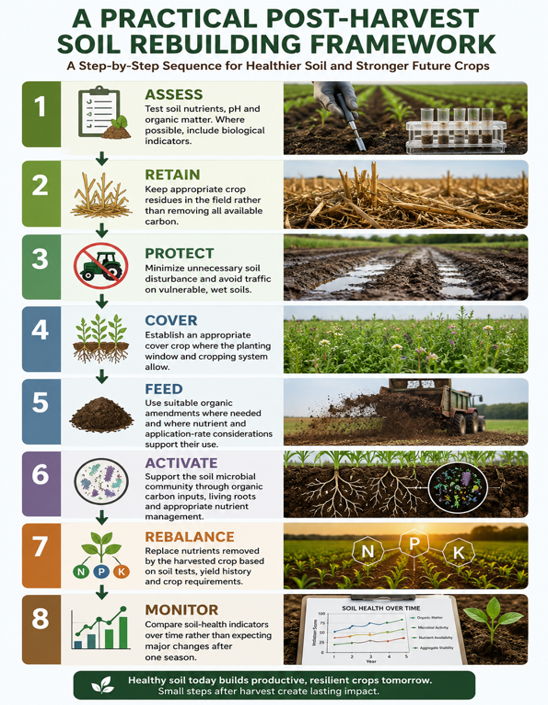
A heavy yield season is a sign of crop productivity, but it also means the soil has supplied and supported that production. Rebuilding soil should therefore begin after harvest by understanding what has been removed and restoring the conditions needed for the next crop. Testing the soil, retaining appropriate residues, reducing unnecessary disturbance, maintaining soil cover, feeding the microbial community, supporting biological activity, and replacing nutrients based on crops and soil needs can work together to improve soil function over time.
There is no single practice or product that can rebuild soil on its own. Soil recovery is a gradual process that depends on organic matter, living roots, microbial activity, balanced nutrition, good soil structure, and careful management. Biological products can be one useful component of this approach by supporting microbial activity and nutrient cycling when conditions are suitable. By treating the soil as a living system rather than simply a source of nutrients, growers can protect the productivity achieved this season and build a stronger foundation for the seasons ahead. The harvest may mark the end of the crop, but it is the beginning of the next opportunity to rebuild the soil.
Disclaimer: This article is provided for educational and informational purposes only. Crop management practices, fertility programs, application rates and growing conditions may vary by crop, location, soil type and production system. Growers should consult a qualified crop specialist, agronomist or other agricultural professional before making changes to their production practices.
Blogger Biography:

Dr. Ankita Garkoti is a Senior Science Officer at Nurture Growth Bio Fertilizer. She has over 9 years of experience in Agriculture research and extension. Her areas of specialization encompass Plant Pathology, Microbiology, Plant Protection, Organic farming, Biofertilizers, Organic Fertilizers, and Biocontrol agents.
She holds a Ph.D. in Plant Pathology and a master's degree in Botany with a specialization in Plant Pathology. Her doctoral research involved an in-depth study of lentil wilt and its management through various practices. She has extensive experience in organizing training programs on Organic and Natural farming techniques for farmers, agricultural growers, students and other stakeholders.
References:
Kumar, K., & Goh, K. M. (2000). Crop residues and management practices: Effects on soil quality, soil nitrogen dynamics, crop yield, and nitrogen recovery. Advances in Agronomy, 68, 197–319.
Li, Y., Zhang, Q., Cai, Y., Yang, Q., & Chang, S. X. (2020). Minimum tillage and residue retention increase soil microbial population size and diversity: Implications for conservation tillage. Science of the Total Environment, 716,137164. https://www.sciencedirect.com/science/article/abs/pii/S0048969720306744?via%3Dihub
Nunes, M. R., Karlen, D. L., Veum, K. S., Moorman, T. B., & Cambardella, C. A. (2020). Biological soil health indicators respond to tillage intensity: A US meta-analysis. Geoderma, 369, 114335. https://doi.org/10.1016/j.geoderma.2020.114335
Food and Agriculture Organization of the United Nations. (2005). The importance of soil organic matter. https://www.fao.org/4/a0100e/a0100e07.htm?utm
Jian, J., Du, X., Reiter, M. S., & Stewart, R. D. (2020). A meta-analysis of global cropland soil carbon changes due to cover cropping. Soil Biology and Biochemistry, 143, 107735. https://doi.org/10.1016/j.soilbio.2020.107735
Hu, Q., Thomas, B. W., Powlson, D. S., Hu, Y., Zhang, Y., Xie, J., Shi, X., Zhang, Y., & Zhang, Y. (2023). Soil organic carbon fractions in response to soil, environmental and agronomic factors under cover cropping systems: A global meta-analysis. Agriculture, Ecosystems & Environment, 355, 108591. https://doi.org/10.1016/j.agee.2023.108591
Hao, X., Abou Najm, M., Steenwerth, K. L., Nocco, M. A., Basset, C., & Daccache, A. (2023). Are there universal soil responses to cover cropping? A systematic review. Science of the Total Environment, 861, 160600. https://doi.org/10.1016/j.scitotenv.2022.160600
Rowińska, P., Gutarowska, B., Janas, R., & Szulc, J. (2024). Biopreparations for the decomposition of crop residues. Microbial Biotechnology, 17(8), e14534. https://doi.org/10.1111/1751-7915.14534


Comments